

1. The Growing Problem With Earth-Based AI Infrastructure

Modern AI models require enormous computing power, which translates into massive energy consumption, cooling needs, and rising operational costs. Traditional data centers are putting increasing pressure on electricity grids, water resources, and land availability. As AI adoption accelerates, scaling this infrastructure on Earth is becoming both expensive and environmentally challenging.
2. The Idea Behind Space-Based Data Centers

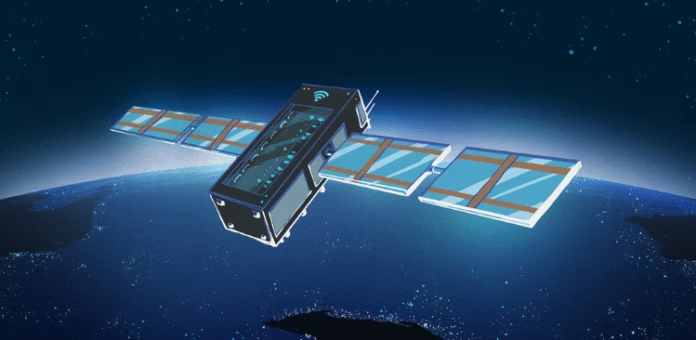
Space-based data centers propose a radical alternative. Instead of housing servers on the ground, AI workloads would be handled by networks of solar-powered satellites in orbit. These systems could benefit from:
Continuous access to solar energy
Natural heat dissipation in space
Reduced dependence on Earth’s limited resources
Despite the promise, this approach is still experimental and faces major technical and economic hurdles.
3. Key Challenges Slowing Adoption
Engineers and space experts highlight several obstacles:
Risk of damage from space debris
Exposure of hardware to cosmic radiation
Limited or no physical maintenance options
High costs associated with launching and replacing satellites
Because of these factors, analysts expect only small-scale pilot projects around 2027–28, with large constellations emerging in the 2030s if early tests succeed.
4. Why Elon Musk Is Pushing This Vision
Elon Musk believes space may soon become the most cost-effective location for AI computing. His confidence is rooted in SpaceX’s dominance in rocket launches and satellite deployment. With thousands of Starlink satellites already in orbit, SpaceX has the technical capability to build AI-ready satellite clusters at scale.
Musk has publicly stated that solar-powered data centers in space could outperform Earth-based facilities within a few years, thanks to lower energy and cooling costs.
5. The Strategic and Financial Angle
SpaceX is reportedly considering an IPO that could value the company at over $1 trillion. A portion of the funding may be directed toward developing orbital AI data center technology. This would position SpaceX not just as a launch provider, but as a critical player in the future of global AI infrastructure.
6. What Competitors Are Doing
Musk is not alone in this race:
Blue Origin (Jeff Bezos): Exploring orbital AI infrastructure, with Bezos predicting gigawatt-scale data centers in space could outperform Earth-based ones over the next decade or two.
Starcloud (Nvidia-backed): Recently launched a satellite running advanced AI chips and real AI models, proving that orbital computing is technically feasible.
Google: Through Project Suncatcher, Google is researching an orbital AI cloud using solar-powered satellites and custom AI processors, with prototype launches planned later this decade.
China: The country has announced plans to build a “Space Cloud,” aiming to deploy large-scale AI computing infrastructure in orbit within the next five years.
7. The Bigger Picture

Space-based AI data centers are not just a technological experiment—they represent a long-term bet on where computing will live in the future. While commercial viability remains uncertain, the companies investing today are positioning themselves to control the next generation of AI infrastructure, beyond the limits of Earth.