

Artificial intelligence is advancing faster than almost any technology in modern history. New breakthroughs appear weekly, AI tools are reshaping healthcare and work, and entire industries are being forced to reinvent themselves in real time. But alongside this rapid progress, a quieter and more unsettling concern is growing — one that even the leaders building AI cannot ignore.
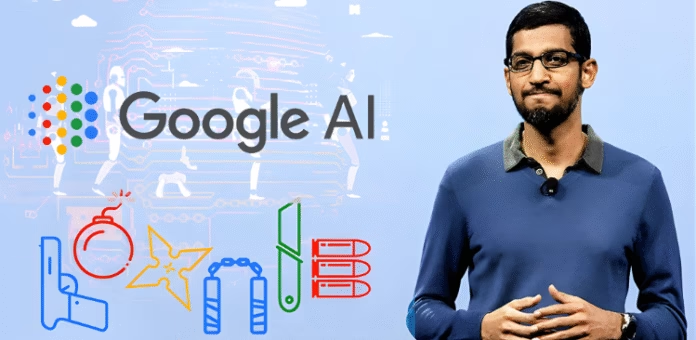
Google CEO Sundar Pichai recently shared what he believes is the most dangerous risk emerging from today’s AI revolution. It is not superintelligent machines or science-fiction scenarios. Instead, it is something far more immediate, far more human, and far harder to defend against: ultra-realistic deepfakes.
The One AI Threat That Keeps Google’s CEO Awake at Night

In a recent interview, Pichai admitted that the speed at which deepfake technology is improving genuinely unsettles him. He warned that AI-generated audio, video, and images are approaching a point where even trained experts may struggle to distinguish real content from fabricated material.
This, he explained, could fundamentally break trust in what people see and hear online. When reality itself becomes questionable, the consequences ripple far beyond technology.
Pichai described a near future where verifying truth becomes a daily challenge — where a video clip, voice recording, or public statement can no longer be taken at face value. That scenario, he said, is what lingers in his mind when he thinks about AI’s darker potential.
Why Deepfakes Are More Dangerous Than Ever

Deepfakes are not new, but what has changed is scale and accessibility. Generative AI tools are becoming faster, cheaper, and easier to use, allowing almost anyone to create convincing fake content in minutes.
According to Pichai, the real danger lies not in the technology itself, but in how bad actors will exploit it. AI-powered deepfakes dramatically amplify the effectiveness of:
Online scams and impersonation fraud
Misinformation and propaganda campaigns
Political manipulation and election interference
Identity theft and reputational damage
When a fake video or voice message can look and sound authentic, the barriers to deception collapse. What once required technical expertise and resources is now within reach of individuals with malicious intent.
The Human Cost of Blurred Reality
Pichai’s concern goes beyond business or platform integrity. He sees deepfakes as a threat to social trust — the invisible glue that holds institutions, media, and democratic systems together.
As AI-generated content floods digital spaces, people may begin to doubt everything: legitimate news, real evidence, even personal communications. That erosion of trust could make societies more vulnerable to fear, confusion, and manipulation.
With major elections approaching in multiple countries, the timing of these concerns is especially critical. A single well-placed deepfake, released at the right moment, could influence public opinion before the truth has time to catch up.
Optimism With a Warning: AI Is Not the Enemy

Despite his concerns, Pichai is careful not to frame AI as inherently dangerous. He frequently highlights AI’s enormous potential to improve lives — from accelerating medical research to enabling breakthroughs in cancer treatment and climate science.
His message is not one of panic, but urgency.
Humanity has faced transformative technologies before, Pichai argues, and has learned how to manage their risks. The difference with AI is speed. Development is outpacing regulation, education, and public awareness.
Without safeguards, even well-intentioned innovation can cause harm.
Why Guardrails Can’t Be an Afterthought
Pichai believes that AI safety must evolve alongside AI capability, not trail behind it. That includes stronger detection tools, content authentication methods, policy frameworks, and collaboration between governments and technology companies.
The goal, he suggests, is not to slow AI down — but to anchor it in responsibility. Trust, once lost, is incredibly difficult to rebuild.
As AI systems grow more powerful, the cost of inaction rises just as quickly.
A Global Warning, Not a Silicon Valley Soundbite

What makes Pichai’s warning especially striking is that it comes from one of the most influential figures in AI development. This is not a critic on the sidelines, but a leader deeply embedded in shaping the technology’s future.
His message is clear: the race is no longer just about building smarter AI. It is about protecting reality itself.
The world stands at a crossroads where innovation and misuse are advancing in parallel. Whether AI becomes humanity’s greatest tool or its most destabilising force will depend on the choices made now.
And as Sundar Pichai suggests, the clock is already ticking.