
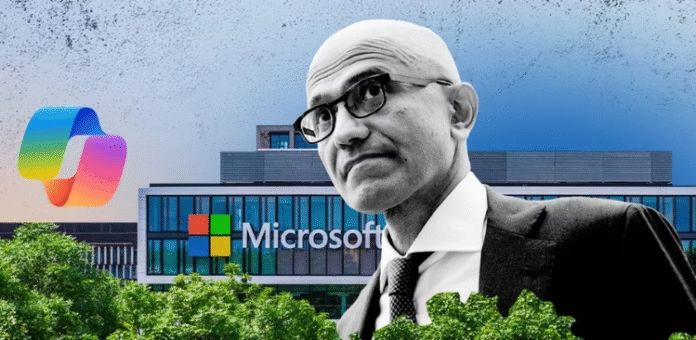
Microsoft is making another strategic move in its AI journey, signaling a shift from rapid experimentation to structured execution. CEO Satya Nadella has announced a major leadership realignment aimed at unifying the company’s expanding AI ecosystem.
At the center of this change is the appointment of Jacob Andreou, who will lead a newly formed division focused on bringing together Microsoft’s commercial and consumer Copilot systems under one cohesive structure.
A unified vision for Copilot

The new division will oversee four key pillars that define Microsoft’s AI strategy. These include the Copilot experience, the Copilot platform, Microsoft 365 applications, and the underlying AI models.
This move reflects a broader ambition to position Microsoft Copilot not just as a collection of tools, but as an integrated intelligence layer embedded across products and workflows.
By aligning these components, Microsoft aims to deliver a more seamless and consistent AI experience for users, reducing fragmentation and improving usability across its ecosystem.
Suleyman shifts focus to superintelligence
As part of this transition, Mustafa Suleyman will shift his primary focus toward advancing Microsoft’s long term efforts in superintelligence.
He emphasized the importance of aligning products, models, and infrastructure under a unified leadership structure. To support this, Microsoft is forming a Copilot Leadership Team that includes Jacob Andreou, Charles Lamanna, Perry Clarke, and Ryan Roslansky.
This team will work collectively to streamline product strategy, strengthen the roadmap, and ensure tighter integration between AI capabilities and user experiences.
A broader leadership transition
The restructuring follows a wider executive shift within Microsoft. Charles Lamanna, Perry Clarke, Ryan Roslansky, and Pavan Davuluri were recently named to a new leadership group replacing Rajesh Jha, who is retiring from his role overseeing experiences and devices, including Microsoft 365 and Windows.
This signals a generational transition in leadership as Microsoft prepares for the next phase of AI driven growth.
A maturing AI market

Industry analysts view this move as a sign that the AI market is entering a more mature phase. Jason Andersen from Moor Insights and Strategy noted that Microsoft is evolving from launching multiple AI tools to building a unified platform.
Many vendors have introduced overlapping and sometimes competing AI solutions, creating confusion among customers about what to adopt. Microsoft’s restructuring aims to solve this by offering a clearer and more consistent experience.
The shift positions Copilot as a comprehensive intelligence platform rather than a fragmented set of features, something few companies have the scale to achieve.
Balancing innovation with clarity
While the move brings clarity, it also raises questions about timing. The AI space is still evolving rapidly, and tighter integration could potentially slow down experimentation and speed to market.
However, the decision suggests that Microsoft is responding to customer demand for solutions that are easier to deploy, more reliable, and deliver value faster rather than simply being first to launch new capabilities.
The next phase of productivity
Nadella highlighted that AI is moving beyond simple tasks such as answering questions or generating code. The focus is now shifting toward systems that can execute multi step workflows with clear user control.
Recent innovations such as Copilot Tasks, Copilot Cowork, agentic capabilities in Office, and Agent 365 reflect this transition toward more autonomous and connected AI experiences.
As these capabilities evolve, Microsoft sees an opportunity to help users focus on higher value work while reducing manual coordination. At the same time, it aims to provide organizations with the governance, security, and control needed to adopt AI at scale.
What this means for the future
Microsoft’s leadership reshuffle is more than an internal adjustment. It represents a strategic step toward defining how AI will be experienced across enterprise and consumer environments.
By unifying its Copilot ecosystem and sharpening its focus on advanced AI capabilities, Microsoft is positioning itself to lead the next wave of productivity driven by intelligent, agent powered systems.
The direction is clear. The future of software is not just AI enabled, it is AI led.