

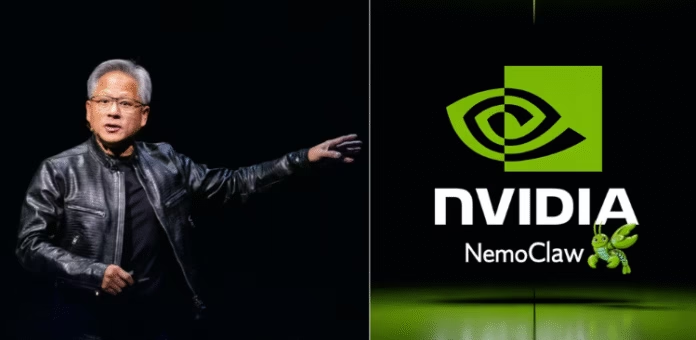
At the Nvidia GPU Technology Conference, Jensen Huang introduced a solution that could redefine how enterprises approach AI agents. Nvidia NemoClaw arrives at a time when agentic AI is growing rapidly but facing a serious challenge around trust and security.
In a matter of weeks, OpenClaw has become one of the most talked about innovations in artificial intelligence. Often described as an agentic operating system, it allows developers to build autonomous AI agents that run locally instead of depending entirely on cloud infrastructure.
This marks a clear shift from cloud driven frameworks such as Microsoft AutoGen, Google Vertex AI, and OpenAI Assistants API. By enabling edge based processing, OpenClaw offers faster performance, reduced latency, and greater control over sensitive data.
However, its rapid growth has been accompanied by significant security concerns.
The security gap that slowed adoption
As enterprises began experimenting with OpenClaw, researchers uncovered multiple vulnerabilities. These included weak process isolation, potential remote exploits, and risks around unauthorized data access and transfer.
For organizations handling critical business data, these risks created hesitation. While the potential of agentic AI was evident, the lack of strong security made large scale adoption difficult.
NemoClaw introduces a new security layer

Nvidia’s answer is not just a patch but a complete security framework. NemoClaw introduces OpenShell, a runtime designed to enforce security policies and protect systems running AI agents.
OpenShell uses kernel level sandboxing to isolate agents from the core system, ensuring they cannot interfere with other processes or access restricted resources. It also includes a privacy router that continuously monitors how data is shared between the agent and external environments.
If an agent attempts to send sensitive data to an unauthorized destination, the system can block that action in real time. This transforms security from a reactive process into a proactive control mechanism.
Why this matters for enterprise AI

NemoClaw directly addresses one of the biggest barriers to enterprise adoption of agentic AI. By creating a secure execution environment, it allows organizations to run AI agents closer to their data without increasing risk.
This enables new possibilities such as autonomous workflows, intelligent automation, and real time decision making systems operating at the edge.
It also supports a broader shift toward decentralized computing, where businesses reduce dependence on centralized cloud systems and gain more control over their infrastructure.
Open source approach with strategic intent
Nvidia has made NemoClaw open source and hardware agnostic, allowing it to run on a variety of systems beyond its own hardware.
At the same time, it is optimized for Nvidia’s ecosystem, which naturally encourages developers already using Nvidia technologies to adopt it more easily. This balance between openness and optimization reflects a strategic approach to ecosystem growth.
The challenge that still remains
Despite its strong security foundation, experts believe NemoClaw does not fully address the deeper challenges of agentic AI. As highlighted by Zahra Timsah, the real gap lies in control rather than just tooling.
Enterprises still require better visibility into agent behavior, stronger governance frameworks, consistent policy enforcement, and reliable audit mechanisms. These elements are critical for ensuring that AI systems operate responsibly and predictably.
The central question is no longer whether agents can run securely, but whether their decisions can be trusted when operating independently.
The future of agentic computing

The rise of OpenClaw and the introduction of NemoClaw signal a shift toward a new computing paradigm. The industry is moving toward a model where software evolves into agent driven services.
If this transition continues, security frameworks like NemoClaw will become essential. They will not only enable adoption but also define how autonomous systems are governed in enterprise environments.
Nvidia has taken an important step forward, but the journey toward fully trusted agentic AI is still unfolding.