

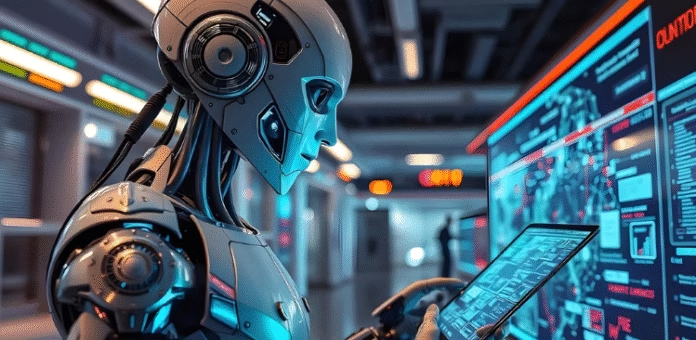
AI is transforming Indian enterprises at lightning speed — powering growth, automation and smarter decision-making. But as AI becomes a powerful innovator, it’s also becoming a disturbingly intelligent intruder. Cyberattacks are no longer coded by humans alone. They now think, adapt and evolve on their own — and Indian CIOs are feeling the pressure.
When a phishing email looks exactly like it came from the CFO, or when malware rewrites its own code seconds before detection, it isn’t a coincidence. AI is doing the heavy lifting for cybercriminals.
This is the new battlefield — where attackers move faster than traditional defenses can react.
And Indian businesses are already paying the price.
According to Fortinet and IDC, 72% of Indian organizations have already encountered AI-enabled cyberattacks. Lenovo’s Work Reborn research digs deeper into how Indian IT leaders are responding — and what it truly takes to stay secure in an AI-driven workplace.
The New AI-Driven Risk Landscape

The era of predictable cyber threats is over. AI-powered attacks behave like living organisms:
they learn, camouflage themselves, and spread across clouds, devices, identities and applications before anyone even knows they exist.
The internal threat landscape is also shifting. Ironically, the same AI tools meant to enhance productivity are now exposing organizations to new vulnerabilities — from over-permissioned accounts to unmonitored use of public AI models.
It’s no surprise that 84% of Indian IT leaders admit they are not fully confident in defending against AI-powered threats.
Their top concerns include:
Polymorphic malware that rewrites itself to bypass detection
Deepfake phishing that perfectly mimics real executives
Data poisoning that corrupts AI systems at their core
Misuse of internal AI tools that exposes sensitive information
AI has completely raised the stakes — and security strategies must evolve accordingly.
What CIOs Must Do Differently in 2025
AI can no longer remain just an innovation engine — it must also become a defender. Lenovo’s Reinforcing the Modern Workplace report reveals that while awareness is rising, capabilities are still lagging.
Key gaps Indian CIOs are struggling with:
65% say their vulnerability and threat analysis tools are insufficient
61% cite weaknesses in identity and access management
60% admit their detection and response systems are too slow
To reclaim control, CIOs need to rethink security from the ground up. Lenovo’s research identifies three essential priorities:
1. Unify the Security Architecture
Indian companies often run dozens of tools that don’t talk to each other.
CIOs must integrate data, security tools and intelligence into a single ecosystem to detect threats in real time.
2. Strengthen Human Resilience
Employees remain the first (and often weakest) line of defense.
With AI-enabled phishing and deepfakes rising, continuous training is no longer optional.
3. Govern AI Responsibly
Clear AI policies, access audits and strong model protections are essential to prevent misuse — both intentional and accidental.
The Barriers Holding Indian Businesses Back
Despite the urgency, the path to AI security maturity is not simple.
Indian IT leaders highlight three major roadblocks:
Complexity (86%) — too many fragmented systems, environments and platforms
Limited in-house expertise (82%) — AI security skills remain scarce
High costs (70%) — scaling advanced protection across hybrid workplaces is expensive
This is where strategic partnerships become critical.
Trusted technology partners like Lenovo bring the AI expertise, managed security capabilities and scalable solutions needed to secure modern digital workplaces.
Building Security That Moves as Fast as AI

For CIOs, the mission is clear:
Use AI not just to innovate — but to see, understand and stop threats faster than they evolve.
Modern security requires:
Unified visibility
Real-time threat intelligence
Automated detection and response
Strong governance over every AI tool used in the organization
The enterprises that succeed will be those that make AI part of their defense strategy, not just their innovation strategy.